


Welcome back to another Wizard of Claws interview!
What is there to say about Midge Raymond that hasn’t been said before? You’re probably all familiar with her as one-half of the power couple behind vegan publishing company Ashland Creek Press, and her and her husband John Yunker’s interview last year on their book Animal Writes continues to be one of my most popular. But today, Midge is going solo to discuss her latest novel, Floreana.
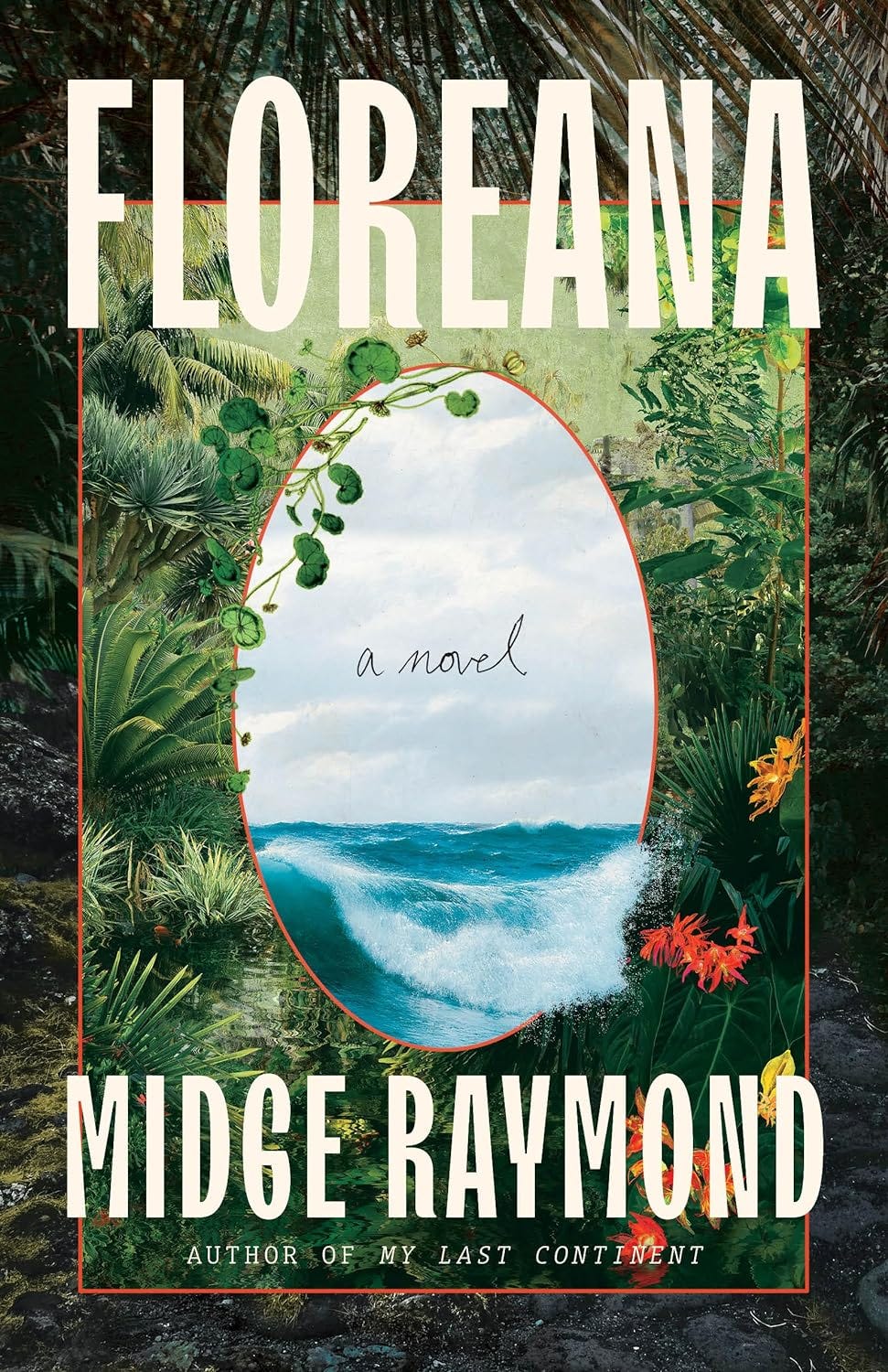
The story follows two women on the Galapagian island of Floreana, nearly a century apart: Mallory in the present and Dore in the past. Mallory’s returning to the island after a decade away to continue her research on Galápagos penguins, while Dore and her partner Friedrich, both vegetarians, move there to start a new life apart from modern society. Dore’s side of the tale is based on real events, the so-called “Galápagos affair” in which a handful of Floreana’s residents disappeared or wound up dead, and it certainly sparked my interest in this 90-year-old cold case (though I find Midge’s version of events preferable to reality).
The novel’s full of love, loss, mystery, and a little bit of murder — something I always appreciate! Without further ado, I’ll turn things over to Midge.
General Questions
You and John are pillars of the vegan literary community. How can writers in our small (but growing!) group better lift each other up and offer helping hands to new and aspiring authors?
By reading vegan authors and sharing books that we love! And by reminding one another that all readers are on journeys of their own — some readers are ready to open their hearts and minds fully to animals, while others are deeply embedded in whatever traditions may prevent them from seeing the suffering. We just have to keep writing and advocating for animals in whatever ways we can. We often have to be subtle — but most important is to be consistent and persistent.
With over four million books published in 2025, there are hundreds, if not thousands, of titles in even the most niche subgenres. Do you think stories centering animal rights themes offer a fresh perspective that could help emerging authors stand out?
Absolutely! Again, sometimes the best way to go is to be subtle — many readers resist animal rights themes because it’s hard to face being a part of systems in which animals are used for food, clothing, entertainment, and so on — but the world of animal rights has so much possibility in terms of literature. There’s drama, intrigue, family dynamics, you name it — when we think of novels like Barn 8 and We Are All Completely Beside Ourselves, we can see how effectively a good book can also open readers’ eyes to what happens to animals.
What authors have influenced your writing the most?
Karen Joy Fowler’s We Are All Completely Beside Ourselves is one of the most gorgeous novels I’ve ever read, and it also happens to be an animal rights novel. And I loved Deb Olin Unferth’s Barn 8 for its focus on chickens, who are among my favorite animals and who so rarely get the attention they deserve. Decades ago, when I first started writing fiction, I devoured short stories — Amy Hempel and George Saunders were among the authors whose stories riveted me. I love the novels of Charlotte McConaghy for the ways she portrays the natural world. And I have so much admiration for vegan authors, especially those writing fiction that is not only a joy to read but has the potential to change the world. Most recently I read Kendra Coulter’s The Tortoise’s Tale, which is beautiful.
Story Questions
I’d never heard of Dore Strauch before reading this book, but I felt deeply connected to your fictionalized version of her in Floreana. (The fact that her closest friend back home is named Elise added another level of familiarity. I almost felt like that friend, reading Dore’s story at a safe distance.) When did you realize that Dore needed a novel, and when did Mallory enter the picture?
I am so glad you felt connected to the fictional Dore. I knew as soon as I heard about the Galápagos affair that I had to learn more about her, and the more I learned about the real Dore Strauch, the more mysterious she became. I knew she needed a novel to tell her story, but because so much has changed in the Galápagos since the 1930s, when Dore lived there, I also wanted to include a contemporary view of Floreana Island. And that’s when Mallory entered the picture. Mallory’s story provides insight into what’s currently happening in the Galápagos and in conservation, but her story connects with Dore’s story in ways that I found surprising and fascinating, given the nearly 100 years between them.
Seeing as Dore’s part of the story is based on real events, how did you determine how true to her real life to be?
This was such a challenge because she was a real human and I wanted to be true to her story. That said, I couldn’t tell the story I wanted — that is, to solve the mysteries of the Galápagos affair — without taking quite a few fictional liberties. I did a lot of thinking, writing, and rewriting to tell Dore’s story, which was inspired by her memoir: not only what she wrote about her time on Floreana but, most of all, what she didn’t write, and the ways in which she contradicted herself at times. Her version of events also contradicted Margret Wittmer’s — there was just so much going on that no one could ever really know, and this is what made it possible to write a fictional version of the story, to fill in those gaps with an idea of what might’ve happened.
There’s a wistfulness to both Mallory’s and Dore’s stories. I read this novel at a time when I was feeling very much the same thing, so there was an element of catharsis to my reading experience, getting to feel the same things as these characters at the same time. Do you find maintaining a consistent tone through a novel comes naturally to you, or do your own fluctuations in mood bleed into your writing each time you return to a story?
My own moods certainly do connect to those of my characters at times, and I’ve often felt the wistfulness that very much defines both Mallory and Dore. In general, I think the overall tone of a novel comes from the characters and what’s happening to them — and in the case of Floreana, the wistful feel of the book comes not only from Mallory and Dore’s personal lives but from the island itself, the changes and traumas it has been through. From being completely isolated to being inhabited and horribly abused by settlers to being brought back to its original state (or as close to it as possible) by conservationists, the island has had the same ebb and flow of drama in its life as the two human characters. So there’s a lot of sadness and history there, but there’s also anticipation: none of them, the human characters or the island itself, know what is coming next — and I feel that there’s a lot of hope for all of them.
Did you write Mallory’s and Dore’s chapters separately or alternate between them, as they appear in the finished product? Did you ever find one of their voices intruding on the other’s storyline?
An early draft of the novel was focused on Mallory, with Dore’s voice coming in through her diary only after Mallory discovered it. But this really limited Dore’s story; she didn’t come into the book until about a third of the way through. Shifting to a dual storyline presented a different challenge, but in the end I think it worked better for both women to have equal time on the page.
Dore writes in her journal, “Did life on this island harden everyone? I did come here hoping to become stronger, but becoming numb to pain, to cruelty, was not a strength I wanted.” We tend to associate strength with forcefulness or violence, while compassion and benevolence are seen as weaknesses. How can we change perceptions to show that compassion isn’t weakness but strength? And when the world so often tries to wear our compassion down, how can we reconnect with our compassion?
Changing perceptions is always a challenge, and for writers, to show compassion is strength rather than weakness, this means creating strong, compassionate characters and letting them do heroic things with their compassion — just as so many real-life heroes have led with their compassion for humans as well as animals.
Reconnecting with our compassion can take many different forms — for example, sharing meals, travel, and other experiences with fellow vegans is compassion in action; it’s doing things out in the world while doing no harm. Spending time with animals is another way — whether it’s your house cat or a chicken at a sanctuary, seeing the world from another being’s perspective is a good reminder to be kind in all ways. And volunteerism and activism are important, too — with all the humans and nonhumans who are struggling, lending a hand in whatever ways we can reminds us there’s an antidote to the suffering.
Motherhood is a big theme in the book. On the island alone, both Mallory and Dore feel the absence of their children, so both turn their affections toward animals instead. Though I’ve never had a child myself, I could relate to their protective love of the animals in their care. Were these themes at all inspired by your own life?
Like you, I’ve never had a child, and I also feel protective love toward animals — not only my own companion animals but any animal who needs love and protection, from stray cats to endangered species. I know so many humans who don’t have children, and we all tend to be extremely devoted to the animals in our lives. I’m not sure this would be different if we had human children, but I do sense that in the absence of human children, animals become especially important. For Dore, these are the abandoned animals she adopts as her own, and for Mallory, these are the penguins whose entire species she’s hoping to protect.
Continuing with the motherhood theme, Mallory thinks, “Conservation, like parenting, gives us a chance to change the future. To create the future.” But Mallory sees that conservation can be cold and violent, too, and any animals that threaten protected species are eliminated. Do you think conservationists today are looking to find more ethical ways of dealing with “invasive” species and “pests”?
It’s such a horrible reality that to save endangered and endemic species, other animals must be killed. And I imagine that looking at cats as “invasive” and at rats as “pests” allows for that bit of distance conservationists need to carry out the awful work of eradicating them. I do think conservationists aim to do the least harm — no one wants to poison or trap or harm animals — but they are dealing with the reality that certain species can’t be protected if others aren’t eradicated. In the case of the Galápagos Islands, it’s not only the cats and rats but so many other animals who had been brought to the islands — goats, pigs, cows. And these animals, just like the penguins and other native species, are just trying to survive; it’s not their fault they ended up there, and it’s sad that they need to be targeted to save the animals that were there first.
Penguins are like recurring characters in your work, connecting the human protagonists, who are otherwise complete strangers to each other, across time and space. What about these birds inspires you?
The first time I saw penguins in the wild, I fell in love with them all. They are serious and goofy at the same time, always waddling awkwardly as they go about the very serious business of providing for their families. They’re beautiful — while they look a bit comical on land while they’re walking around, a penguin standing on a beach has a certain quiet dignity. They’re incredibly graceful underwater, strong and fast. They’re smart. They co-parent. They’re survivors: Many species are monogamous, if conditions allow; they’ll stay with the same mate as long as they can, but if their mate disappears, they find another because it’s their most important job to bring more penguins into the world.
When working on a book, especially one with such a strong sense of place as Floreana, do you do anything to immerse yourself in the story world, like eating specific foods, listening to music/sounds from that place, etc?
My immersion includes lots of research; even though I’m writing fiction, I want the setting and science to be as accurate as possible. So I love the research process. And I look at tons of images and videos — often ones I’ve taken but also from other travelers, scientists, and so on. And for me, writing always involves lots of snacks!
What was your favorite part of writing Floreana?
Finding Dore’s fictional voice was a fun challenge and took a long time, beginning with reading her memoir and everything I could find that was written about her — and then letting go of all that and recreating her as a fictional character, while also trying to stay as true to who she was as possible. I feel as though the Dore of Floreana is very much like the real Dore, only in the novel she gives herself more agency, stands up for herself, and has a much happier ending.
Another favorite part — and another challenge — was braiding Dore’s and Mallory’s stories in a way that fit well and made sense. It was like putting together a puzzle. I wanted each woman’s story to be entirely her own, and I also wanted to show the ways in which things have and haven’t changed — both in the Galápagos and for women — over the past century.
Final Questions
How can readers find you and your work online?
My website: MidgeRaymond.com
Any upcoming projects?
I’m working on a couple of new projects that feature penguins, and I am enjoying every moment. Every species is so different, so the research is a lot of fun. And of course the human drama is fun, too — I’m immersed in family dynamics, love affairs, secrets and lies — the humans are always doing things that surprise me.
Anything else you’d like to share?
In addition to writing, I’m often teaching — most recently a workshop called Writing Wild, which I’ve taught at San Diego Writers Ink — and also Writing for Animals, hosted by Ashland Creek Press. I enjoy not only sharing all that I’ve learned about writing about animals and wild places but being in conversation with other writers who share their work. It’s inspiring all around.


