


Welcome back to another Wizard of Claws interview!
We’ve gotten to hear from some picture book authors in the past, but for the first time today, we have a graphic novelist! I never picked up many comics or graphic novels in my youth, but I’ve come to appreciate the art form much more as an adult. A blend between prose and visual arts, it seems like the perfect medium for stories about animal rights.
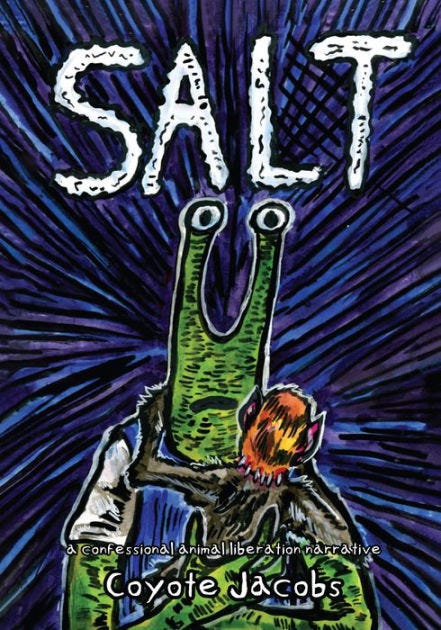
Our featured book today, SALT, follows Silas, a kindly, sensitive gastropodic alien whose roommate rescues a young monkey, later named Oslo, from a lab after being subjected to a full head transplant. Grisly stuff, and inspired by real events, too. Though the main characters aren’t human, the book makes you lose whatever faith in humanity you had left, but through Silas’s compassion, author Coyote Jacobs helps restore it, at least a little bit.
General Questions
Can you share a little bit about yourself, including how you came to care about animals and the arts?
I often joke I was “raised by dogs,” and it does not feel entirely like a joke; my family had a rotating number of dogs, and growing up I likely spent more time with them than with other kids. I have not read a full Temple Grandin book and probably never will because I’ll be too upset, but when she describes growing up thinking in pictures, “feeling like an animal” and different from others, she sounds like she’s describing me; we just have taken very different paths with similar tendencies. She designs slaughterhouse equipment, I care for animals rescued from slaughterhouses.
I have always made art, and I have always been around animals; I can’t recall a time when I wasn’t. Of course, my ethics and life path had to become more articulated as I grew up. I honestly don’t know if I’m capable of being anything besides what I am now, an artist, a dog walker, an animal rescuer. Even writing this, I struggle to articulate what I’m feeling. Words feel like they fall flat, and images are a lot easier to get my feeling across.
Most animal advocacy focuses on creating tangible changes in the real world. What role can the arts play in changing how people think about animals?
This is the question that took me the longest to respond to, because I struggle to feel hopeful many days. I believe art, such as SALT or other works, gives people an in to understanding animal rights, thinking that they otherwise would never attempt themselves. I very intentionally did not have the characters talk about veganism explicitly, not because I was hiding, but because that’s not how I talk or think; I think in relationships. I wanted to bring people into the world, the mind of someone who cares a lot about animals, and I hope they are able to work backwards from there, recognizing that if they are cheering on the rescue and recovery of Oslo, then they ought to consider the tangible ways they can help or hinder real animals. Veganism is the logical conclusion of having an honest relationship to other animals.
What role does intersectional advocacy play in your life, and how would you like to see other social justice advocates connect animal and human rights in their own activism?
I think intersectional ways of thinking are the only reasonable conclusion one can come to after genuine research and exposure to the world we live in. Human and animal rights don’t need to be connected because I think they are the same thing.
I wish mainstream veganism would not pretend animal rights activism exists in a vacuum, that making ourselves as non-partisan as possible is somehow a good thing. When I saw PETA and a couple of other Animal Orgs congratulate Donald Trump for placing some supposed restrictions on animal laboratories, I cringed. This is a man that is the leader of a movement that has very much harmed the lives of my neighbors and me. The Big Beautiful Bill cut down my 76 year old neighbors’ foodstamps from $180 a month to around $24 a month, one of his first executive orders was to not allow trans people to get passports with their gender marker. Another was to remove environmental protections to make it easier to move private businesses into National Parks, and another was to remove parts of the Endangered Species Act. I know I am preaching to the choir here, but I feel frustrated. Frustrated that the largest animal rights organizations are failing us so monumentally by pretending animal struggles and human struggles are not connected, by isolating themselves self-righteously from other liberation movements. By making trans people, black people, immigrants, and many women feel unsafe in “vegan” communities, of course the movement is going to suffer. By claiming to “only be about the animals,” it seems very clear to me that many more conservative vegan groups are very self-centered, as they would not challenge themselves or make themselves uncomfortable by confronting their bigotries to welcome the insight of other social justice movements.
I think you’re the first author I’ve interviewed who published with Lantern. Was working with a vegan publishing house important to you, and can you walk us through the process of working with their team to bring the book to publication?
The very first copies of SALT were printed at my college and I learned how to cut and bind them by hand. It was tedious, the books were all a little misshapen, I wasn’t that precise at cutting. The covers of those first books didn’t hold up well, just being plain card stock they frayed and warped. But that’s how I started sharing it, I’d just send it to friends, I sold maybe 2 or 3 at events. Frankly, I had no idea how to publish a book. My book getting published by Lantern was a miracle, and I am so thankful. I actually did not approach them directly, asking to get my book published. I messaged Rebecca, who runs a wonderful bird sanctuary called the Institute for Animal Happiness, asking her opinions on where I could print more copies of SALT, and since I knew her husband Brian works at Lantern, I figured she may have some insight for more environment routes for printing. And lo and behold, she had something even better and told me I needed to just meet with Brian directly about publishing.
Story Questions
The fact that this story was inspired by a real experiment in which a scientist transplanted the head of one rhesus macaque onto another is incredibly disturbing. How did you hear about this story, and when did you realize you wanted to fictionalize it in a graphic novel? (And why is humanity the literal worst?)
The first time I read about the rhesus monkeys was in Peter Singer’s Animal Liberation. I must have been 15 or 16. It’s a mention in his chapter about vivisection, these experiments done in the 40s and 50s surrounding consciousness. There are several documented reports of scientists stitching the head of one individual onto the body of another animal. Singer mentioned there was a YouTube video of one such study, of research where smaller dogs were sliced, alive, from the shoulders down and sewn onto larger dogs. I typed in the video URL from the cited sources in the back of the book. The image of those dogs, stitched together, confused, in a new type of suffering never before seen, is seared behind my eyes. The story of monkeys getting head transplants was there, too.
To me, I think these studies show a synthesis of human arrogance and entitlement. Most of the YouTube comments on the videos of the monkey’s plight were not about the monkey, but about the morbid fascination, about how thrilling, yes gross, but important this research was. All I can think about is what it felt like to wake up on someone else’s body, someone else whose consciousness was snuffed out so your head could be stitched on theirs.
At one point, Silas thinks about Oslo, “I can tell she’s confused by this alien body.” Though readers may not look as “alien” as Silas, being vegan often feels like being an alien, like we’ve crash-landed in another, crueler universe. Why did you want to make the main characters aliens rather than humans?
The main reason the characters aren’t humans is that I don’t have any fun drawing humans, but I wanted a story involving humans, so I had to figure something out! I love to draw my little snail men, they are more expressive, more dynamic than I could draw a human character.
Ashley Capps writes a beautiful description of the metaphorical meaning of salt in the book’s afterword, but that’s not directly addressed in the story itself. What does the title mean to you?
I really struggled to title this work, and it was not until well into it I settled on SALT. As a young child, I have a memory of some big fat slugs crossing the pavement, myself and other kids squatted above them, watching them inch along, when one of the kids got an idea and ran back inside, shouting “watch this” and returned with a shaker of salt. When salt was poured over them their skinned bubbled, they writhed. It was horrible. And we were just children, we couldn’t have been older than 6 or 7. As with so much cruelty, it was not a calculated act. It was stupidity and callousness.
I confess I don’t know much about artistic style, but the thick lines and bold colors of your illustrations are striking. I couldn’t help but feel that the heaviness in the strokes conveys a heaviness in emotion, and I could feel Silas’s fear, anxiety, and despair in the art alone. How did you develop your artistic style? And how can art sometimes elevate a message even more than words?
Style is one of those things you just find yourself doing without consciously taking a path there. My style was forced to loosen up, and will probably only get looser as my wrist and fingers continue to hurt more and bend less. I am very much inspired by comic artists, like Josh Bayer who I briefly TA’d for, and of course, R. Crumb. Comic artists have spent decades perfecting ways to have simple ink lines convey every emotion, so I have very much taken from a long line of artists.
I think in pictures. Even writing this response was challenging; I struggle to say exactly what about art is so important to me. It’s like breathing, I just do it and need to do it. I do think SALT was able to bring people who would otherwise never give explicitly vegan literature a chance and have their assumptions about animal rights challenged.
When taking care of Oslo, Silas thinks, “I don’t like being in this position. A position of power. Someone at my complete mercy. A position in which to cause harm.” We often think of animal rescues as beautiful, healing things, but they come with a heavy emotional burden. The amount of pain and trauma rescued animals experience is something most of us could never, hopefully, fathom. To have their fragile, vulnerable lives entirely in our hands can be terrifying, paralyzing. Were these words inspired by your own experience with rescued animals?
They absolutely were. I have fostered and otherwise taken care of a number of animals of many species. And the truth is, I am not better than anyone else, I am not infallible, and ultimately, I wish I never had to take care of any animal at all. I have failed them many times, not because I didn’t care, but because there is a margin of error. By virtue of being human, there is a gap in understanding and a power dynamic.
I think very early into rescuing animals, it was purely exciting; it felt like a great relief to be helping these domesticated, human-harmed animals live something closer to a liberated life. It still feels good to help, but it is more terrifying. Yes, I can help a chicken escape certain death in a slaughterhouse, but she is still in the care of clumsy human hands. Hands that can build a faulty enclosure, or make the wrong medical decision that ends up killing her. As rescuers and vegans, I think it’s important we don’t fall into a savior complex. There is still so much to learn about animals and so much that can be missed from not listening and observing them very carefully. Good intentions alone are not enough to escape inherent human flaws.
Silas thinks that “the universe isn’t cold and it isn’t warm. It just is.” Do you agree with that?
Yes. I think while I was working on SALT it was one of the first times I was truly tackling some of my self-hating, self-punishing tendencies. Growing up Catholic, it was reinforced that when bad things happened to me, it was because I was bad. It was the universe punishing me. In truth, things just happen because the world is not in our control, and that is something scarier to submit to than living in a world where someone or something is in control, even if that thing hates you. My dismantling of my faith and my relationship to animals is very much the same thing. I started questioning my faith when folks would tell me dogs did or didn’t go to heaven, based on what they thought I wanted to hear. Even in the version of the afterlife where dogs did get to go to heaven, it was spoken of in relation to human wants, of wanting their pets back, not objective truths about an animal’s value or sentience. Chickens, as bright and as innocent as dogs, are killed in the most horrific ways, and there is no talk of heaven for them because it’s not something humans take comfort in. So it’s been important to me to accept that the universe has no intentions. No intentions to harm me, or deny heaven to chickens or the oppressed, nor does it want to help; it has no intentions at all, it just is.
I love how Charles Waltz-Rieber describes what happens to animals as “banal violence” in the foreword. It’s a feeling I think of often, every time I read a book where an otherwise empathetic main character eats animal flesh or every time someone tells me about the lovely trip they took to the zoo. Charles also writes, “SALT is about the fervent distress of grief and hope uniting to motivate animal activism.” What do you hope readers take away from this story?
I hope they come away with more understanding than they did before of what the animal rights movement means and desires. I hope they come with more empathy and caution when they encounter the next sensationalized story involving an animal, pausing to think about what it must have felt like to be that animal.
Final Questions
How can readers find you and your work online?
My Instagram is @Coyote_Illustration and my portfolio site is coyotejacobs.cargo.site/.
Any upcoming projects?
I am doing a fundraiser show with several other artists in Brooklyn later this year to raise funds for Brooklyn Animal Action, August 8th!


Fascinating interview. Especially the piece about conservatism in the vegan community. It sure is real and it sucks.