

Interview: Marybeth Holleman
On polar bears, metaphors, and the boundlessness of climate change

Welcome back to another Wizard of Claws interview!
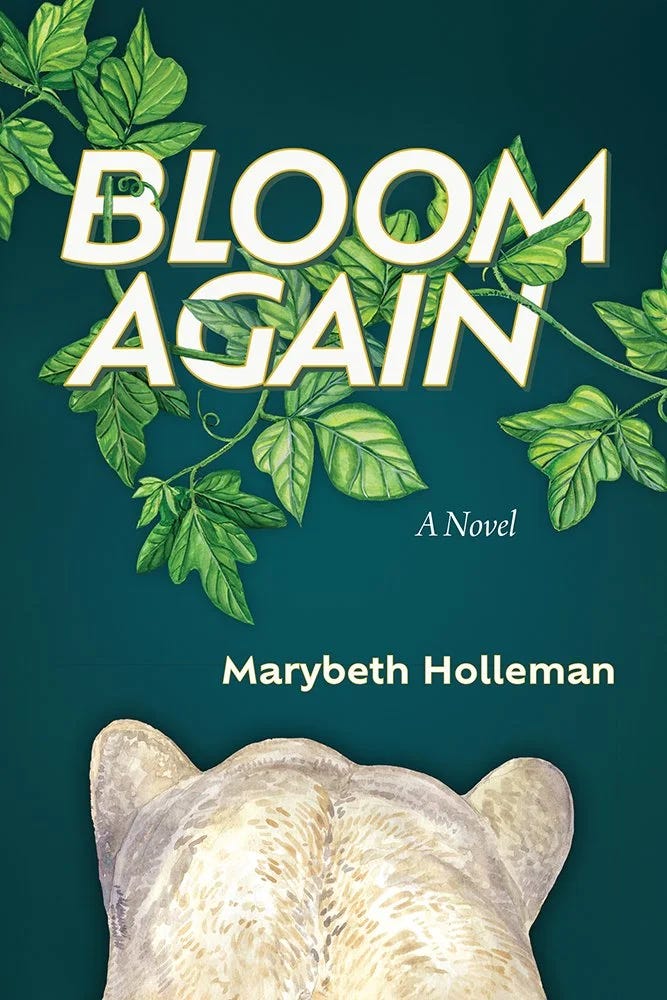
We’re going north today, far, far north to Alaska. I’m sure we’ve all seen photos and videos of scrawny polar bears adrift, alone on a small piece of ice or sluggishly swimming through a seemingly endless sea. We all know the icecaps are melting and polar bears are dying, and though we acknowledge that that’s a tragedy, it’s hard to know what we could possibly do to help them. Marybeth Holleman writes about that very struggle in Bloom Again. The novel follows childhood friends Elyse (yay, same name!), an artist, and Astrid, a paleobotanist (yay, dino-plants!), as they struggle to find a balance between art, science, and advocacy in their work. Marybeth will go into more detail on that below, so let’s get to it!
General Questions
Can you share a little bit about yourself, including how you came to care about animals and creative writing?
I’ve always been in love with the more-than-human world. Growing up middle child in a large family, I retreated to the woods where I could hear my own voice. Sometimes it was just climbing onto the garage roof and sitting among the branches of dogwood, pine, and mimosa, listening to the birdsong. There I found companionship with the trees and squirrels and foxes and birds. I felt, and still feel, more at home when I am with them.
As I grew, I wanted to protect them. The first Earth Day, as a child, I was delighted to realize that the more-than-human world needed me, too, just as I needed it. My first job after college was in environmental policy—I naively thought that if science was properly conveyed to policy-makers, then the right decisions would be made, on behalf of the entire living, breathing world. I soon realized that things are more complicated, that humans make decisions not just with their minds, but also with their hearts, emotions, experiences. I realized that what had formed my connection with the more-than-human world was my time in it as well as the books I’d read, from The Jungle Book and The Wind in the Willows to The Monkeywrench Gang.
So, I turned to writing. And found there a way to use the voice I’d first heard in childhood woods, to reveal human relations to the more-than-human world. And this is what I focus on in my writing, whether essays, poems, or fiction: we’re only going to be able to sustain life on earth if we recognize, value, and participate in our vital, necessary, integral, intricate relations with all beings on earth, and to do this, we have to be able to listen to more than just human voices.
Most animal advocacy focuses on creating tangible changes in the real world. What role can the arts play in changing how people think about animals?
We don’t make decisions based on rational thought alone. We also make them with our hearts, our emotions. So what’s needed is for art and science to work together, for us to wed our hearts and minds. Art can bring science to life, can illuminate the world in ways that speaks to us in a much deeper way.
Art and science and advocacy, they’re all pieces of the puzzle. When I wrote Among Wolves, I was deep in Gordon’s research on wolves, but what brought his data alive were the stories of individual wolves. What inspires advocacy are those personal stories, personal experiences. And art nourishes advocacy as it enlivens science, involving minds and hearts.
Art is vital to any significant and lasting change in how humans relate to other animals. As Elyse in Bloom Again said in her application for an artist residency, “art can reach people in ways that science can’t. It bypasses the analytical mind and goes straight to emotions and imagination, creating understanding and empathy.”
Most mainstream fiction that prominently features animals is mired in metaphor, as if the animals are merely vessels to illustrate human concerns. (Stories like Wicked come to mind.) How can authors better balance animal metaphors with human stories?
Ah, yes, this is so true. Animals are used metaphorically, and not allowed agency. I noticed this early on, and have in my own writing sought to flip that script and be the vessel through which animals are allowed to reveal some of themselves.
What I strive for in everything I write is to give voice to the more-than-human world. To do this, to allow agency, I try to get out of the way, to not always be the “I” in the middle of every scene. To not have every scene revolve around a human. And at the same time, to know and remember my filters: that I am human, and therefore will never completely know what it’s like to be a bat, or a praying mantis. So all I can do is my best, knowing I can’t ever get it quite right.
In tender gravity, I have a poem called “Prodigal.” The name, of course, comes from the Biblical story, but the poem is very much about birds: the ones who stay here all winter, and the ones who migrate here in summer. They are embodied, their sounds are evoked. And then at the end, I bring in us humans, bringing us in relation to them.
What’s one piece of advice that’s helped you improve your writing the most?
Reading. Reading authors whose work I admire, whose use of language I admire. Early on, I let myself mimic them. For example, the beautifully-written essays of Gretel Erlich in The Solace of Open Spaces.
Poetry, especially, has helped my writing. I start every writing day by reading a poem, just to, as the poet Jane Kenyon said, “have good sentences in my ears.” And then I follow that by writing a poem of my own. A poem a day. Most of them go no further than that morning ritual; it’s mostly about exercising my writing muscle, setting the tone for what I do then write.
But I can’t emphasize enough: read. Read your tribe. Don’t worry about sounding like another author. Maybe in the beginning you do, but as you write, and read, and read, your distinctive voice will naturally arise.
Story Questions
What inspired you to write about polar bears, and what do you hope readers will learn about them by the story’s end?
I’ve been writing about polar bears for a long time, ever since learning of their dire situation, and ever since spending time with them in the wild in Kaktovik. I’ve written essays, poems, articles, position papers for NGOs. But it never felt like enough. Then I realized that fiction could do more, could explicate more of who they are.
For a long time now, they have been the poster child for climate change, and we’ve all read and seen some iconic images, but over time, we’ve grow immune to their plight. They’ve basically become a metaphor for climate chaos. For most people, they’re not really real. Most of us don’t get to see wild polar bears, don’t get to witness them in their habitat being themselves. Zoo animals, as we know, act differently, though not by choice.
What I want in this novel is to make them real, make them more than metaphor or poster child. I want readers to truly see them. I want to show their individual personalities, their relations to their home ecosystems, and, yes, their resiliency. As one bear biologist said at a conference I attended, “They’re not just going to lay down and die.” They’re going to strive to survive. What I want is to make their dire situation and their very real lives so close to our own that we can’t turn away.
In “Other Nations,” your essay in Writing for Animals, you say that writing about wild animals authentically is “rooted in direct, unmediated experience.” What sort of experiential research did you do to create Bloom Again?
I drew on my own experiences in the Arctic, with wild polar bears in Kaktovik, with the Alaska zoo’s polar bear (yes, parts of Binky’s story are true), my travels in India, my growing-up years in North Carolina, and my life here in Anchorage. And, more intimately, I drew on my direct experiences with the more-than-human world, whether a childhood moment in a kudzu cave or a hike in a beetle-killed forest of the Chugach range.
Writing from what I know into something new, I let the characters take the story where it needed to go. So, I haven’t been everywhere they go, haven’t experienced everything they have, but that’s why it’s fiction. Yet it’s still rooted in my direct, unmediated experience. For example, I haven’t been to Siberia, but I have spent time in Arctic villages doing research. So I could draw on that lived experience and on conversations with those who have experienced the land and cultures of Siberia. I wanted this book to include places and beings who are often overlooked when we talk about the effects of environmental destruction. I wanted to show the expanse of climate change; how it knows no boundaries; how it’s harming all of us.
At the beginning of the novel, both Elyse and Astrid think back to the kudzu of their youth. Elyse draws inspiration from this in her art, painting a tangle of those vines around a polar bear. It strikes me that kudzu, though invasive, is still beautiful, still worthy of artistic depiction. In that way, kudzu is like humanity. We invade and unthinkingly throttle life wherever we touch the natural world, but humans are still valuable and beautiful, and our art demands attention. It creeps into our heads and changes our inner ecosystems, no matter how we try to fight against it. What inspired this connection between kudzu and polar bears?
Oh, I love that you got this connection, that you recognized the role of Kudzu in this story! Yes, exactly, we humans are the most destructive invasives on the planet, by a long shot. But: we are also beautiful and valuable, as is Kudzu. Linking Kudzu with Polar Bears, that was a moment of divine inspiration that at first I thought was crazy. But, as the story progressed, I saw how Kudzu had a lot to offer.
Kudzu, who I grew up with in North Carolina, contrasts with polar bears, since Kudzu is considered an invasive who is destroying natural habitat, and Polar Bears are endangered, are, in fact, at risk of “falling off the Earth,” as one character in Bloom Again says.
I find that contrast interesting, especially in regard to our thinking about “invasives.” Kudzu was intentionally brought to the U.S. from Asia as an ornamental and to prevent soil erosion. Humans brought this plant to this place. And now we are maligning them. What if, instead, we consider that things are more complicated? Not who wins and who loses, which is how humans often think about things, but rather, who’s in relation to who now, and how are those relationships changing, and can we see these changes and work with rather than against it?
Big questions, to be sure, but vital questions, I think. Consider how we value wild beings so differently depending on how well they get along with us. Kudzu, or seagulls, or rats, do well around us, yet we despise them and call them vermin and try to kill them off. I’ve wondered if we humans, deep down, must know how destructive we are being to the planet and all the wild inhabitants, and if this feeds our hatred of the ones who get along with us, a kind of transference, blaming them instead of blaming ourselves, which would be too hard to admit...I don’t know...big questions, like I said!
Polar Bears were the first characters who I knew the story would revolve around. Kudzu appeared as a surprise, vining their way into the story, and, in the end, weaving it all together.
In “Other Nations,” again, you write, “Writing about the nonhuman world is a practice in standing in the middle. Straddling sentimentality and detached hard-nosed Cartesian rigor without sliding lazily into anthropomorphism or leaning too far into anthropocentrism.” Elyse and Astrid come from different worlds. One an artist, the other a scientist, yet they both find that middle ground through advocacy. Elyse’s art is even referred to at one point as an “exciting blend of art and science… Sublime advocacy for the Earth.” How can creatives find the middle ground between art, science, and advocacy?
I think that middle ground is different for each one of us, and shifts over time and with each new project. But I also think it’s a very, very important place to find.
Early in my career, I read an essay by Rick Bass in which he tackled this very question. When your house is on fire, he said, you don’t sit on the lawn and write a poem about it; you blast water on it. So, it depends on what’s going on—do I pick up the pen or the sword?
In Bloom Again, Elyse is at first overwhelmed by all the world’s needs. But she then finds her path by seeing what she is uniquely able to do. So it’s finding what we have to offer the world, how we are best of use, what we are uniquely suited to do, and what nourishes us. I started out working in policy, but learned that’s just not me. A friend who’s a singer and is also very good at organizing people, she’s at the forefront of all our rallies right now. You do what you’re good at, and what feeds you. As writers, we are fed by our writing. So if we write about what matters, what we’re passionate about, then it just naturally is, I think, advocacy.
And I’ve just always been drawn to both science and art. My first year in Alaska, I did a project with the Forest Service on trumpeter swans. From that came one of my first creative essays. Working in the field with researchers, learning what they knew and what they didn’t, I realized that science doesn’t dispel the mystery of life on earth, it deepens it. Art, too, deepens the mystery, helps us see things in a new light.
It’s good to remember that we haven’t always divided things up this way. Think back to the Renaissance, to Leonardo da Vinci, who didn’t restrict himself to being only an artist or a scientist or an inventor.
Another character comments to Elyse that the polar bear’s name at the zoo, Binky, is disrespectful. Much of the language we use for animals disrespects and objectifies them, minimizes their lives and inner worlds. In what ways can authors utilize language to reframe readers’ preconceived notions about animals?
Yes! We do see them as objects. This is an old, outdated Descartesian model of nonhumans as some kind of automatons. And, as with using animals as metaphor, It’s also frustrating that so many stories have the animal, rather than the human, die. It’s such a cop-out.
Overall, I try to use the same conventions used for writing about humans when I’m writing about animals and other living beings. For example, I no longer use “it” when referring to a specific animal, or other living being. We don’t refer to humans that way; why would we do that with nonhumans? Another thing I try to avoid is referring to other living beings as “species.” That’s a scientific term, so for me, it only tells part of the story. “Being” is my preferred term now.
Art that centers the natural world has always been the most interesting to me, because nature is naturally beautiful and meaningful. It is life, it is story, it is art. It doesn’t have to try. I think of artists almost as prisms, rather than creators, allowing nature to advocate for itself by refracting its story in a way that touches upon human values and interests. As such, it was disappointing to see so many people in Elyse’s life fail to realize that art is inherently advocacy. All artists have a message they’re trying to share, both about themselves and the wider world. Do you think people are becoming more accepting of the fact that art and advocacy are necessarily intertwined, that art is an essential element of advocacy?
Early on, I knew I wanted this book to explore the intersections of advocacy with art and with science: what happens when scientists and artists advocate? How are they seen differently by their peers, what happens to their funding, etc.? From biologist Gordon Haber to many of my biologist and artist friends, I witnessed the way advocacy hampered their ability to be taken seriously by their peers, by funding sources. It’s not easy speaking your truths. But if you don’t, and you have valuable information, then we just get farther away from any hopeful future.
So, yes, I think this is still a challenge. Artists want to appeal to the greatest audience possible, and in so doing, they can get caught in a sort of conundrum between their initial inspiration and what they think others want. And scientists want to be able to get funding for their work. Elyse and Astrid struggle with this.
I think creatives of all genres mostly want to be creating for the pure joy of creation, and not be pigeonholed or labeled as an “environmental writer” or anything. So that’s the catch. I think you’re right, it’s impossible to create without some message, because our inspiration arises from some reaction to what’s going on in the world.
Setting is just as much a character in the novel as the humans and other animals, and setting is a character in our own lives, too, playing a critical role in forming our thoughts and habits. We often take that for granted. As Elyse thinks, “If only we could love place as much as we love self.” What advice would you give other writers for bringing their settings to life?
In writing The Heart of the Sound, I wanted to give voice to Prince William Sound and its wild inhabitants. I wanted the book to be a love story, a story about my love for and my relationship with this place. An agent wanted me to revise so that the Sound was merely a backdrop for the human story—and this is the common thing, isn’t it—so I passed on her offer. But it made me realize how unusual it is for place to be centered in story.
As writers who want to center place, it’s important to spend time in the place, time alone in it, big stretches of time in it. To feel it breathing, feel its life, hear its voice. And, of course, to have a field notebook to jot down what you learn and feel and can bring into your writing. Then, put your human characters in the place, but to scale. In so many stories, and often in our daily lives, we’re so often out of scale with the rest of the living world: we loom large and take up so much space that place and other beings fade to background. Instead, see humans in our true scale. We’re actually pretty small in a rolling field or beside a big oak tree or on the ocean or a wide, long beach.
I’ve heard about the plight of polar bears basically my whole life. It’s something everybody knows. But that knowledge seems to have collectively calcified in our brains, becoming a permanent, immovable fact. And that can make us complacent, make us feel like it’s impossible to do anything to reverse the trajectory of fate. How can literature, or stories and art more broadly, help shake us of such doomed thinking about animals and the environment?
Like most of us now, I can easily slip into despair about all we’ve lost, and all we’re poised to lose...about all the ways we as humans have failed to live on this gorgeous planet with wisdom and awareness and respect for all the other lives who share it with us. Despair, anger, frustration, grief...it’s very easy to go there; I spend a lot of time there. And not just because the news is full of it, but also whenever I see something different, a newly fallen tree, for example, along a familiar trail, I stop and think, is this because of our weirding weather? Is this because of the new bike trail carved through here that cut off some roots? Is this because of something we humans, in our mindlessness, have done?
What I’ve found is that, as Rumi wrote, “the cure for the pain is in the pain.” That is, for me, to just get myself out on that trail, and walk, and notice everything. All the dead spruce trees, and all the saplings pushing up with their new needles. Getting out into the natural world will inevitably make me feel better. More empowered. Avoiding the despair only makes it cling more strongly. I have to face it, step into it, and just keep walking. And the natural world never fails to give me solace, and lessons on how to be. I notice the lives around me, the chickadees flitting from branch to branch, the plumping of the rose hips, and I’m reminded of how they are always in this moment, nowhere else, and so I put myself in this moment, nowhere else.
And then to turn and write about/of/for/with them, that can open my despair into a sense of power, even delight. It’s very exciting when I feel as if the words I’m writing are just coming through me, that I’m just the conduit, for something beyond my small human self.
Literature, art, stories can open our despair and doomed thinking to a sense of power, possibility, even delight. It can remind us that the ending is not yet written, that all these other beings we share this planet with also have power, resilience, and agency. I often recall that wonderful Wendell Berry poem, “when despair for the world grows in me...I come into the peace of wild things who do not tax their lives with forethought of grief.”
I’ve been thinking a lot about the role of hope in climate fiction lately. Cli-fi is often apocalyptic or dystopian — not a stretch when we see the world both burning and drowning around us — but, similar to my last question, reading about the planet in mortal peril can paralyze us and make taking action feel pointless. Even so, no matter how dark a story gets, they nearly all end with hope. Case in point, Elyse and Astrid feel “a hope rooted in action” at the story’s end. Even in the face of catastrophe, why do we keep clinging to hope?
I’m going to lean on the late, great Jane Goodall here. She said, “People tend to think that [hope] is simply passive wishful thinking: I hope something will happen but I’m not going to do anything about it. This is indeed the opposite of real hope, which requires action and engagement.”
And as Strilay, Astrid’s mentor in Bloom Again, says, “There’s hope, and with it, the call to action.”
So, I always pair hope and action. Otherwise, it does feel useless, doesn’t it? And, yes, most cli-fi is very apocalyptic. I didn’t want to do that. I rooted this novel in reality; it doesn’t veer into science fiction at all. Every bit of science and fact in it either has happened, is happening, or could, given what we know right now, happen. And, yes, in the beginning, Elyse is paralyzed by the hard reality of climate chaos. But what draws us out of despair is action. So she begins to feel her way, to act. Even the smallest-seeming thing that we can do—free a small sapling who’s been trapped by windfall—can wake us out of despair. Despair is useless, really. So for me, for my characters, it’s always about, what then shall I do?
Final Questions
How can readers find you and your work online?
My website is www.marybethholleman.com
Facebook: Marybeth Holleman
Instagram: mbhalaska
Bluesky: mbhalaska
Any upcoming projects?
The Alaska Literary Field Guide, which I co-edited, just came out earlier this year. It’s a beautiful mix of art and science and poetry, all praising the wild beings of Alaska. And I’m at work on another book which is prose and poetry speaking to each other, I’m inspired by working in mixed forms now!


