

Interview: Sara Ackerman
On empathizing with sharks, listening to animals, and connecting with nature

Welcome back to another Wizard of Claws interview!
A few years ago, the front page story in my local newspaper was about a “shark attack.” But it was no attack, at least not an unprovoked one. The man who’d nearly lost his arm led boat tours, hooking sharks and hauling them from the ocean so eager tourists could snap photos with them. It’s a chance to face the beasts that swim through our nightmares and emerge victorious. Dominant. The story ended with the man recovering in the hospital, calling for shark hunting restrictions to be lifted, claiming that sharks had been allowed to proliferate, thus making the waters unsafe for humans. I immediately penned a letter to the editor to push back against the paper’s alarmist, speciesist rhetoric and explain the shark’s side of the story. Pulled from their watery home, in pain from the hook, unable to breathe, terrified they might die, the shark acted in a way that would label them a hero had they been human, fending off their kidnapper and escaping alive. Sure, the shark may have attacked the man, but the man attacked first. My letter wasn’t published.
I didn’t grow up watching Jaws, except for seeing a few snippets on TV when I was home from school for the summer, but sharks have always fascinated me. Something about how feared they are by others makes me admire them. So when I read EcoLit Books’ review of The Shark House, there was never any question of whether I’d read the book or not—it was a matter of when. And I couldn’t resist for long. The novel follows Dr. Minnow Gray, a marine biologist specializing in white sharks, as she investigates a series of shark “attacks” in Hawai’i. It’s a beautiful, captivating novel with a deep appreciation for sharks and oceanic life at its heart. Sharks are lucky to have writers like Sara Ackerman on their side, and readers are lucky that books like this are being published. Without further ado, let’s hear from Sara herself!
General Questions
Can you share a little bit about yourself, including how you came to care about animals and creative writing?
I have always written poetry, but one Wednesday in 2012, I sat down on my porch to write a novel. I had no idea how to write a book and no idea where it was going, but six months later I somehow managed to finish it. I told everyone, this may be the worst book ever written, but at least I wrote it! With a bit of constructive feedback from friends, a few key books on writing, and a couple of writers conferences, I learned a few things. Not only that, but I kept at it and in 2018 my first novel (the fourth one I had written by then) was published. And I’ve always been a huge animal lover, so it just seemed natural to include animals in my books and even making them important characters. So far I have dogs, cats, donkeys, sharks, nene geese, a featherless chicken, endangered Hawaiian crows, horses, sharks, and even a lion.
Many of us have childhood dreams of becoming writers. When did you decide to give it a shot?
There have been times throughout my life when I finished a book and thought, I want to be able to write my own! I’ve always loved reading and writing, and used to compile books of my poems and give them out as gifts every year for Christmas. But it wasn’t until 2012 that I sat down and started writing my first novel. I was hooked right away, but I didn’t land an agent and publishing deal until my fourth one (Island of Sweet Pies and Soldiers). When I started, I knew it would be a long process since I had no MFA or formal training in fiction. I had a Post-It note that said Patience & Perseverance stuck to my door frame. That was my mantra.
Once you’ve finished a draft of a book, how do you, your agent, and your editors all work together to get the manuscript into its final form? What kinds of feedback do they most often give you, and how do you know when to accept/reject their edits?
Before handing it to my agent, I do a quick read through and clean it up (this is often painful because I see all the work it needs), then she reads it and gives feedback. I’m lucky because my agent Elaine Spencer is a fabulous editor. I’ll make as many changes as I can and then send it to my editor (as of this writing, I’ve had 6 editors across 10 books). I’ll then get a long letter with detailed notes on how to improve my story (sometimes I cry because this is where the real work begins and it can be brutal). For the most part, though, their suggestions are brilliant and helpful and they make the book so much better. There have only been small things that I did not agree with, so I’ve never really had to reject edits.
I find that I write better when I’m reading books I really love. Are there any external factors that influence your writing or flow?
I agree. I like to have books on hand that I can just leaf through to see how they navigate starting chapters or transitions or beats. Or a certain style or idea that sparks something in me. I also value walking in nature as I’m writing. It gives my mind space to wander!
Story Questions
Minnow has a pretty traumatic backstory, and it’s something she wrestles with throughout the book. As I reflected on this, it made perfect sense to me that she would connect to animals as much as she does. Her pain is born from sharks, and sharks’ pain is born from humans. But Minnow’s healing is also born from sharks, and humans have the power to heal the hurt we’ve caused sharks, if we choose to do so. Was this a parallel you entered the book trying to make, or did that arise organically as the story developed?
I think this arose organically. I’m never quite sure where some of my ideas come from, but it seemed like the right thing to do to make her situation more complicated and layered, as often is the case in life. I love that we have the power to heal and I hope more people become attuned to this. I feel like awareness is growing, but not fast enough.
Let’s get the Jaws question out of the way now. Obviously, that book/movie had a huge impact on the perception of sharks worldwide, and as a horror fan myself, I still can’t resist a shark movie, despite knowing that they’re propagating the same monstrous misinformation from fifty-plus years ago. Do you think, as a society, we’re finally unlearning all those damaging myths about sharks?
I think we are. Some of the stuff I see on TV or streaming is helping sharks and others is still hurting them. I also follow several shark photographers on Instagram who shoot with drones (mainly in California) and we can see how many white sharks are cruising the waters with swimmers and surfers (who have no idea the sharks are around them) and just totally minding their own business. These guys have a lot of followers, so people are seeing this in real time. I find it very encouraging to see.
Having a solid understanding of shark behavior must have been essential to writing this book. Did you do all (or most) of your shark research before working on plot development, or did you research as you wrote?
I did a lot of it beforehand. Watching documentaries, reading books, and talking to shark experts. As I write, though, I usually have to look things up, and that was the case here, too. Since my story evolves as I go, I don’t know what I need to know until I get to a particular scene. The research for this book was so much fun! But it also made me have sharks on the mind when I was doing ocean swims and I was always expecting to see some massive shark emerge from the depths.
Whenever humans come up with reasons to use or kill other species of animal, we develop a language system that others and denigrates them as well as reinforces anthropocentric beliefs. Minnow experiences this firsthand. People call sharks “monsters” and “man-eaters” who viciously and violently “attack” humans — yet they also edge away from saying that hunts kill sharks, preferring the euphemistic term “take” instead. We see this kind of doublethink all the time with animals, whether it be the ones we’re afraid of, like sharks, or the ones we eat, wear, and use in other ways. Was this focus on the language we use about sharks inspired by your research, and has writing this book shifted the language you use to speak about sharks?
Yes it was. I did not know that scientists refer to “attacks” as incidents, since the shark is often just sampling a foreign object with its mouth. Or sometimes they mistake humans for seals. There was a lot I did not know before I set out to write this book, but I did learn some information years ago when I first read The Devil’s Teeth by Susan Casey.
I’m a sucker for journal entries and other interstitials between chapters. Not only are they an organic way of sprinkling in exciting shark facts, but they also give us a more intimate glimpse into Minnow’s head. When did you decide to include those little moments from Minnow’s life in the book?
Right from the start. I knew there would have to be a way to get this information in there in a creative way. And journal entries were perfect. But I wanted to keep them short(ish) so not to pull the reader from the story. Aside from shark facts and her experiences with them, I thought it would be fun to catalog Minnow’s thoughts on sharks from a young age. And I always love an excuse to write a poem or two!
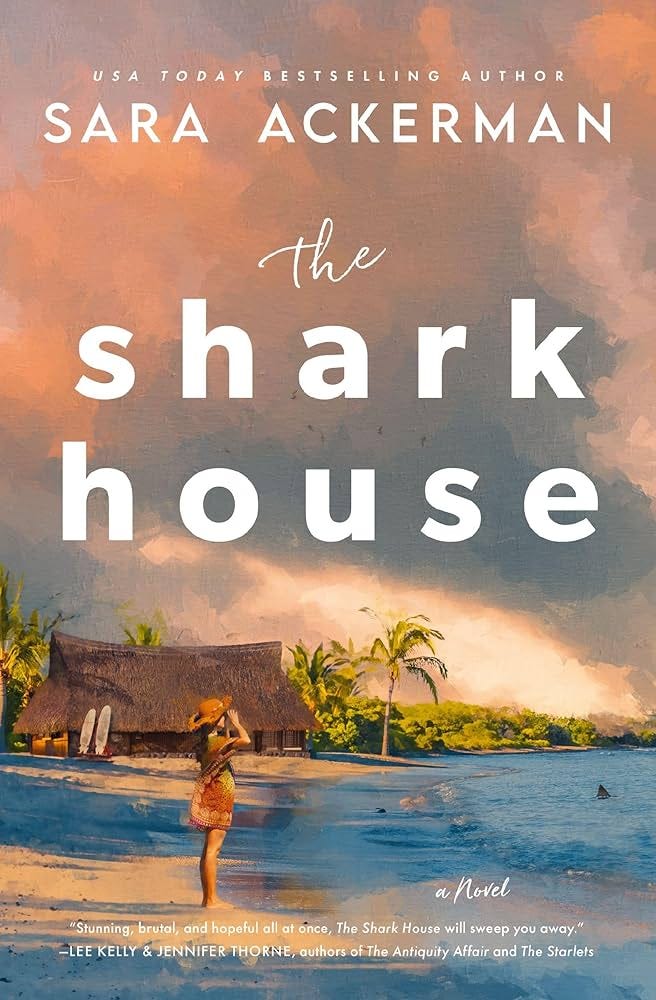
We’re told to never judge a book by its cover, but we all do it, and I’m absolutely in love with this one. How much input do you have on your book covers?
Thank you! I love this one too. Harper Muse does great covers. I sent them a bunch of photos of the Kohala Coast and underwater shots, and some other book covers I love, and they took what I gave them and came up with this. Aside from getting the shark fin right, I had no changes to the first concept I saw. Which has never been the case. There is usually a ton of back and forth to try to get things right and at some point I just have to accept things as they are.
As mentioned in the discussion questions in the back of the book, Hawai’i is like its own character in this novel. It feels just as alive as the beings who inhabit its land, waters, and skies — perhaps it feels alive because of those inhabitants. If authors are unable to visit the places about which they’re writing, how can they breathe life into their settings?
When I’m writing about a place I’ve never been (mainly in The Maui Effect & The Uncharted Flight of Olivia West) I watch footage of films or documentaries set in the location. And I try to read descriptive pieces that really drop me into the place, as well as pinning some key photographs. I’m lucky, though, I’m usually writing about Hawai’i and places I know intimately.
As you wrote beautifully, Minnow “was born of whale song and tiger shark and undersea things.” She feels most at home in the water. She’s embraced the animal side of her nature, but most of us have not, or we’ve lost that connection. Despite walking on the earth every day and living in wondrously complex ecosystems — even those of us landlocked in concrete jungles — we are so separated from the earth and our nonhuman cousins. But, as Minnow knows, the “earth and animals spoke to those who were willing to listen.” How can we learn to listen to them?
The best way that I know is to spend time in nature, in wide open spaces and among towering trees. Or in the ocean. And with animals too. To be present and soak it all in. The more time the better, without phones, without an agenda. Just forest bathing at its finest.
There’s a dusting of magic over Minnow’s story. She learns about the deep spiritual connections native Hawaiians have with sharks, and, as a scientist, she enters the story already knowing how important they are to oceanic ecosystems. She even has a little magic of her own, an ability to connect more deeply with the natural world than many others, an ability born from her deep reverence for nature. Have you experienced any of that magic in your own life?
I have experienced the magic of feeling at one with nature and sensing the magic all around us, but I don’t have heightened senses like she does. I wish!
Final Questions
How can readers find you and your work online?
Website: ackermanbooks.com/
Instagram: @saraackermanbooks
Facebook: @ackermanbooks
Any upcoming projects?
I just revealed the cover today for my next book (#10!) The Volcano Keeper. A story about a volcanologist who lands a highly coveted job at Hawaii Volcanoes National Park in 1984, unsure if she is up to the task after a tragedy in the field. Mauna Loa is stirring, its tremors subtle but unmistakable, and point to a dangerous instability. But her reasons for coming to Hawaii go deeper than that — she is also there to unravel the disappearance of her grandmother during the wartime ‘Secret Eruption’ in 1942. A mystery that has haunted her family for decades.


