

Interview: Jay VanLandingham
On dystopias, intersectional connections, and enjoying the writing process

Welcome back to another Wizard of Claws interview!
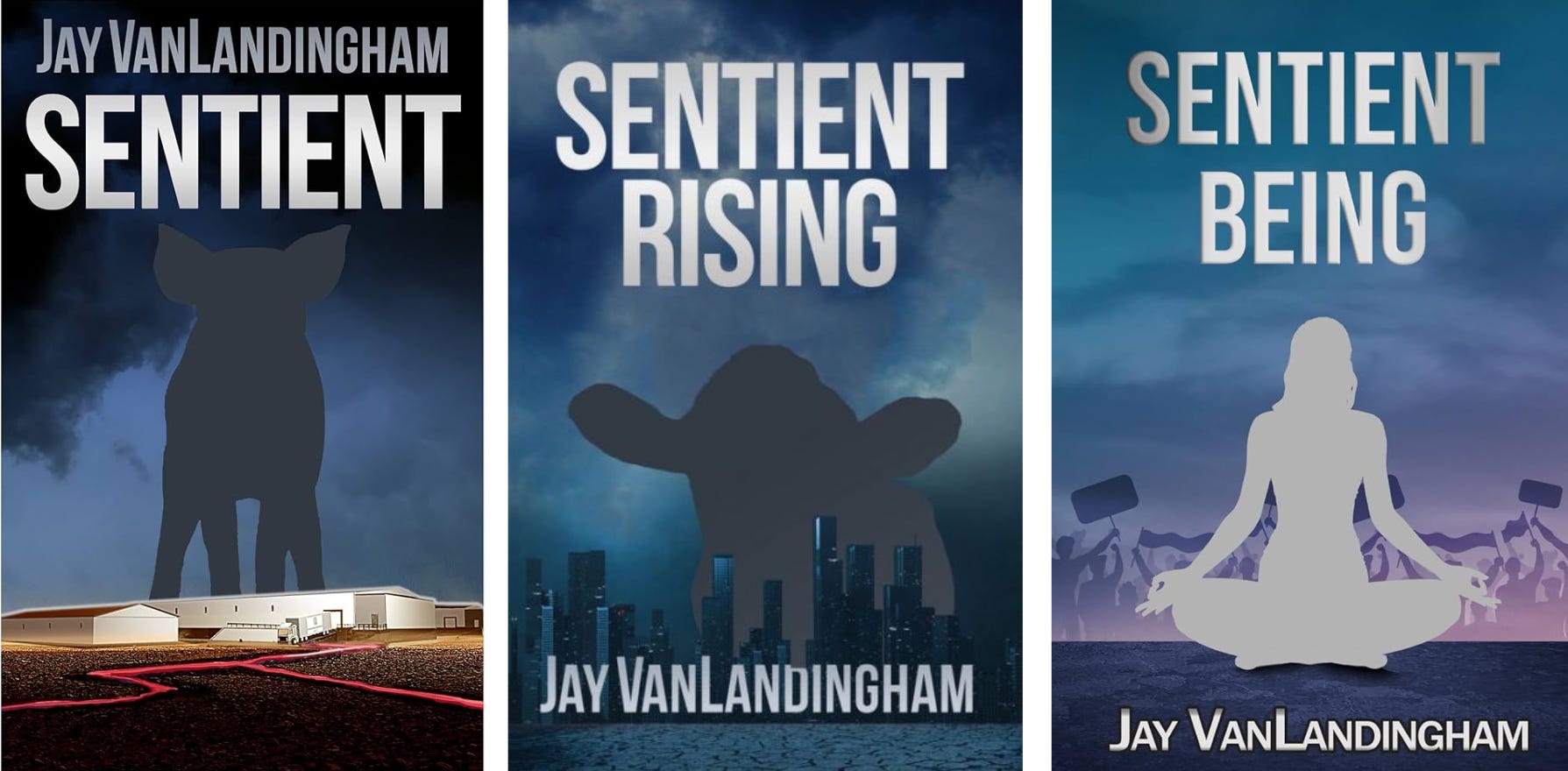
Today’s a special day because we have a returning author here for the very first time! In last year’s interview, Jay VanLandingham and I discussed his short story “The Movement of Whales,” but today we’re focusing on his dystopian trilogy, Sentient, the final book of which was released last May. I always love reading Jay’s Substack for his thoughts on writing, so I’m sure you’ll love this interview, too!
General Questions
Has your writing process changed since we chatted in your interview last year? In your newsletter, you’ve discussed how you’re trying to focus more on the internal joy of writing rather than on reaching certain external goals. Has that changed your outlook on writing at all?
Yes, my writing process has changed. Maybe because I have changed (and am always changing, to some degree). I came to realize that I wasn’t going to be happy by rushing through book writing just to get to the end game, just to have something published and “out there,” with the hopes it would lead to my success as an author. I had to reframe what success meant for me, in order to become more happy. Today, success means enjoying the moment. With my writing, I’ve learned to sit and enjoy the story. This is the only time I will have to write this story. One day, the story will end, and I’ll likely never encounter those characters and those experiences ever again. Making the most of the process, rather than focusing on the outcome, has led to a deeper enjoyment. I take my time with each chapter. I give myself more than a year, if that’s what it takes, and it has significantly improved my experience and, I believe, my writing. Readers will find that out for themselves with my next book.
With the abundance of podcasts, books, online courses, workshops, articles, and newsletters, it’s never been easier for aspiring authors to cultivate a relatively inexpensive, DIY education. What made/makes up your curriculum? What resources have you found most helpful?
Great question! I go with what works best for me. I’m not much for podcasts or online courses, I admit. I like books. Some of the ones I refer to and have used the most are “oldies but goodies,” such as Word Painting by Rebecca McClanahan, which is great for learning description; The Writer’s Journey by Christopher Vogler; Writing Down the Bones by Natalie Goldberg. The other trick I use is to simply read as many fiction books as I possibly can, especially in the genre I want to write. Reading fiction is the best resource.
What part of the writing process comes most naturally to you? What part has taken the most work?
Overall, writing first drafts and allowing for the mystery has come most naturally to me. Allowing for “shitty first drafts,” as Anne LaMott has said. What takes the most work, and something I alluded to in the first question, is taking my time with revisions. Not rushing the revision process, and allowing a book to take as long as it needs before readying it for publication.
Any plans to give traditional publishing a shot in the future?
I am definitely considering traditional publishing for my 4th novel, particularly a small press, if the fit is right and the contract is fair.
Story Questions
Where did you get the idea for the Sentient universe? How much of the series’ story arc did you know from the beginning?
The idea developed over time. I knew that for some of the themes to work that citizens needed to be living in isolation/separation, but completely disconnected from nature. I knew climate change had to be a factor. The idea that animal activists were living in hiding (or disappeared), came from many books I had read on the subject, such as Green is the New Red by Will Potter. Much of the idea came from the true experiences of activists, undocumented immigrants, and of course animals, that are intertwined within the system of animal agriculture (not that we all aren’t).
As far as the story arc goes, I had a vague understanding of what needed to happen, much of the “bigger picture” elements, in view from Book One. Much of the details came along as I wrote the books. And of course there were plenty of surprises, as the characters emerged and began to write themselves.
Many vegan writers dabble in the speculative fiction sphere. What do you think it is about this genre, or dystopias specifically, that presents such a rich setting for vegan authors?
Dystopian fiction provides the opportunity to explore how far into darkness humanity can go. For vegans like myself, it is already dark enough, what I know and have experienced/learned as an animal activist throughout the years. The world of animal agriculture can be cruel and sadistic. Dystopian fiction may actually lend the reader to being more open to consider what “might happen” if our world continues in its current trajectory, as far as climate change and the perverse exploitation of nature are concerned. And, alternatively, I believe Dystopian fiction can also show readers a glimmer of hope, that no matter how dark things can get, there is always a way to make things better. There is always an opportunity to be more proactive in preventing the possible realities that Dystopian fiction presents.
The world as it is today already feels quite dystopian. Why did you want to set your dystopian story just two decades in the future?
Exactly what you said: the world as it is “already feels quite dystopian.” When I first conceived of this series, it was 2013. I set the series in the 2040s because I believed there was a possibility that by 2040, much of what was occurring in the series might actually come to be (I don’t actually believe that to be the case), creating a greater sense of urgency and horror for the reader. At the time, I thought that if readers could see this as “close and present danger,” it might propel them to act faster to address climate change and animal agriculture.
Your three main characters in the Sentient trilogy all have very different backgrounds. How do you approach writing characters whose life experiences differ so drastically from your own?
I do my research, first and foremost. For Bertan, the undocumented immigrant working in a slaughterhouse, I read tons of books (Every 12 Seconds by Timothy Pachirat), watched videos, and interviewed undercover animal activists. Once I feel I have enough research to start, just as with any character, I learn about them. I do my characterization, and I learn about the person, remembering that we are all pretty much the same, underneath. It’s just about discovering the character’s fears, desires, and motivations, and making sure to understand their culture, race, ethnicity, getting sensitivity readers to check myself before I wreck myself. ;)
When Bertan is working on the kill floor at an S-Corp slaughterhouse, you show how the animal agriculture industry strips everyone of identity. The workers call the cows “beefs”; the workers all wear diapers because they’re not permitted bathroom breaks; and the workers are rarely referred to by their names but more often by their position on the kill floor. Bertan eventually starts to forget even his own name. After all, “no one much cared how anybody felt in a place like this.” I especially like the description of the company’s structure, with the outward-facing employees working in the part of the building nicknamed Heaven, the management offices nicknamed Purgatory, and the “Dirty Side” employees working in Hell. Why did you feel it was important to draw comparisons between how S-Corp treats its employees and how it treats animals?
In my experience, non-vegans have even less education regarding the treatment of workers in animal agriculture than they do the treatment of the animals themselves. My writing coach, for example, was shocked to learn that close to 50% of all workers in this field are undocumented. So in part it was to educate the reader. In addition, due to the cognitive dissonance that exists with regard to the treatment of animals in factory farms (most people are aware that animals are treated horribly but cannot bring themselves to stop eating animal products), so I wanted to make the connection that when we treat an animal with cruelty, that cruelty can easily extend to humans. Thus the factory workers.
Upon escaping the hospital and seeing a vast stretch of wide, open land, Bray thinks about “how all this land could’ve been used for farm animals” but wasn’t. Those of us concerned with animal rights can often be reminded of the injustices animals face by innocuous things like empty land. When something catches you by surprise like that, how do you deal with the subsequent emotions?
Well, I write about it (thus the Sentient series). This entire series is essentially me processing my feelings, the powerlessness and helplessness, primarily, that I feel with regard to the seemingly impossible situation of the use of animals for food, testing, etc, etc. And sometimes I process with other vegans. Community is super important for that.
In episode two of The Animalist Code, Emerson writes on his blog, “How do we stop this animal cruelty without community? Without one another? The world has us so divided that we don’t come together to fight for what’s right anymore.” In your opinion, what can we, as activists, do to build communities and set aside superficial differences to work towards a common goal?
I wish I had an answer for this one. My personal feeling is that activists need to find a way to accept some middle ground, in order to work together. I’ve witnessed animal activists shaming and verbally attacking other animal activists for differences in beliefs, when we are all a part of the same team, aren’t we? We need to find ways to set aside our own personal beliefs and focus the things we can agree on, and start there. Let the pettiness go.
Emerson’s trans identity isn’t a source of conflict in The Animalist Code; no one shows animosity toward him simply because of his gender. (Kage, on the other hand, doesn’t get off quite so easily.) Was that an active decision, or simply a result of the short story format?
It was not an active decision. It was, in part, due to story length, and situation. Emerson lives in a time/place where he does not, as a vegan, have to remain in hiding. Transition is an option for him, and so “passing” in social situations is possible. For Kage, who had no chance at starting HRT, gender-affirming surgery, and the like. Not to mention I wanted to show that parallel between being trans and not having access to care and being an animal and being trapped in a factory farm without access to nature.
Do you see a relationship between trans and animal activism? Are there any parallels between the fight to normalize trans and animal rights?
See previous answer. I do see a relationship between trans and animal activism, in that we are all deserving of equality, regardless of being human, non-human animal, trans, cisgender, etc, etc. Equality is intended for everyone, but how do we get there? The fight to normalize trans rights is similar in that what we transgender individuals seek is that freedom to be ourselves. To live in our true nature. I believe the fight for animal rights is the same; that animals are given the same rights as humans, to be free to roam and live without exploitation.
Since the Sentient stories deal with strong animal rights themes, how did you approach finding critique partners, beta readers, editors, etc?
I was lucky that one of my beta readers is actually a vegan writer. But honestly, I found it more helpful that my editor and other beta readers were not at all knowledgeable or invested in animal rights. They, after all, were the audience I was aiming for with this series.
You’ve spent years in the Sentient universe. How does it feel to finally be finished?
It feels surreal. As if it did not happen at all. I think that’s why, with this fourth novel, I’m taking my time. So I can enjoy every last bit of it before it’s over.
What do you hope readers of the Sentient books can learn about life, love, and activism in the real world?
That it starts with acceptance. When we can accept ourselves, others, and the way life is today, it doesn’t mean we are giving up. Acceptance creates energy and space for right action. Life is paradox and mystery and none of us have 100% of the answers. Only in all of us coming together, unifying, and choosing to love differences, can we become the answer. That love in action means finding ways to accept and to be in community with those that are not like-minded, not living in a bubble.
Final Questions
How can readers find you and your work online?
My website: jayvanlandingham.com
Substack: substack.com/@jayvanlandingham
Instagram: @jayvanauthor
Any upcoming projects?
Yes! No title reveal yet, but I will have some short fiction and a fourth novel coming…soon 🙂
Anything else you’d like to share?
Thank you for the opportunity, I appreciate it.


Thank you both for this. Jay's message of acceptance really helped me today.