

Interview: Elizabeth Stiles
On maintaining hope, writing new perspectives, and the limitless power of love

Welcome back to another Wizard of Claws interview!
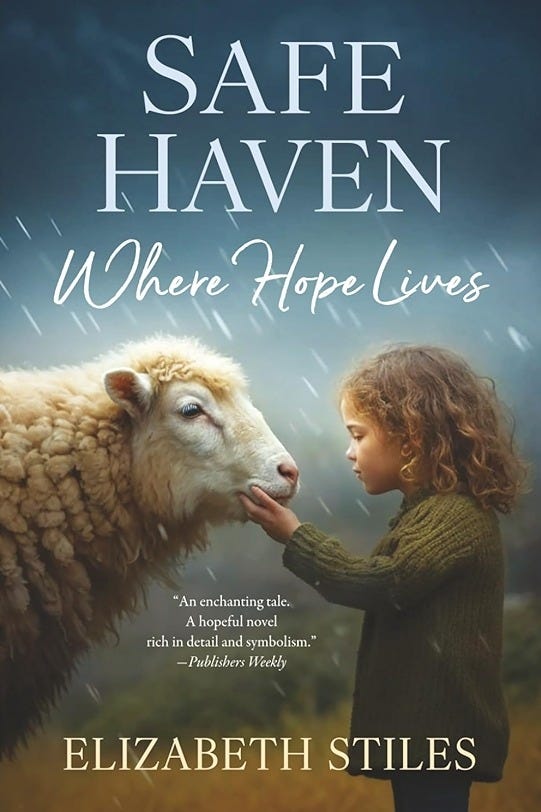
Today, we have a lovely, thought-provoking interview with Elizabeth Stiles, who’ll be discussing her debut novel, Safe Haven — Where Hope Lives. The story follows Michael, a man recently out of a job, who buys an old farmhouse in the countryside, and his daughter Brie. As the plot unfolds, Brie battles against bouts of intense illness that suddenly arise out of nowhere. This is the kind of book that tugs at every heartstring you have but leaves your heart stronger and fuller by its end. Enjoy!
General Questions
Can you share a little bit about yourself, including how you came to care about animals and creative writing?
I’ve always had a deep love for animals. Growing up, there was never a time when I didn’t have a companion—whether it was a hamster, a cat, a dog, or even a horse for a few years. Animals have always been an important part of my life, and I truly can’t imagine living without them. They bring me hope, comfort, and a sense of connection that has shaped who I am. I discovered the joy of writing in fourth grade, when my teacher helped me publish Fin, my very first picture book. Its pages were cut from blue construction paper, its cover wrapped in bubbly aquamarine wallpaper, and though it was only presented at an interschool fair, the words and illustrations were mine. For a nine-year-old, it felt monumental. I’ve rediscovered that joy while weaving my love of storytelling and my passion for animals into narratives rich in character and emotional depth.
Many of us have childhood dreams of becoming writers. When did you decide to give it a shot?
I had dreamed of becoming a writer since childhood, but life initially carried me in other directions. At fifty, while searching for a way to make a meaningful difference in the lives of farmed animals, the idea of writing a book truly took root. One evening, a story came to me, but when I tried to capture it on paper, I realized I didn’t yet have the skills to do it justice. That realization became a turning point—I committed the next decade to honing my craft with guidance from creative writing experts, determined to bring Safe Haven to life in the most authentic and powerful way I could.
Most animal advocacy focuses on creating tangible changes in the real world. What role can the arts play in changing how people think about animals?
The arts have the power to plant a seed that can grow into lasting change. A story, a painting, or a film can spark curiosity and compassion, inviting people to pause and reflect. Art can challenge assumptions, encourage us to question what we’ve been taught, and to see the world differently. It opens a window into perspectives we may never have considered—through the eyes of animals themselves. In doing so, the arts can become a catalyst for cultural transformation, shifting how we think and feel about animals. Ultimately, they help move society toward empathy, justice, and respect for all living beings.
Sharing our stories can sometimes feel more vulnerable than sharing our feelings. It’s like the stories we make up come from the deepest, most sensitive parts of ourselves. Do you have any advice for aspiring authors on gaining the confidence to share their work with others?
I once received advice that has stayed with me: cut a vein open and bleed all over the page. In other words, don’t hold back—write with honesty, vulnerability, and emotional investment. If you aren’t willing to pour yourself into the work, your reader won’t feel compelled to invest in it either. As you mentioned, sharing our stories can feel deeply vulnerable because they come from the most sensitive parts of ourselves. But that vulnerability is what makes them resonate. Confidence grows when you accept that your truth, however raw, is worth sharing—and that authenticity is what will connect you to your readers.
What are your reading habits, and how do they influence your own writing?
As a writer, I’ve found that reading takes on a different dimension. I’m not just enjoying a story—I’m studying how an author shapes their voice, crafts sentences, chooses words, and reveals character and plot. Every book becomes both inspiration and instruction. I try to read broadly, but most often I’m drawn to non-fiction for research and to fiction as a way of honing my craft. Both feed my writing in different ways: non-fiction grounds me in knowledge and context, while fiction sharpens my sense of style, rhythm, and emotional resonance.
Spoilers ahead!
Story Questions
As activists, we often look to younger generations to be changemakers. Less entrenched in speciesism, we find hope that they will be the ones to end the atrocities we commit against animals. Is this where the inspiration for Brie’s character came from?
While my hope is that future generations will be changemakers, my inspiration for Brie’s character came elsewhere. After reading the first draft of Safe Haven, my mentor said, “You can talk about animal suffering to people until you’re blue in the face and they won’t listen. But talk about a child suffering and you’ve got their attention.” That’s when I knew I’d hit on something. If I could show the suffering of animals through the eyes of a child, perhaps readers would see it differently; maybe even question their own views. My deepest hope is that Brie’s perspective could encourage empathy that, in time, might translate into change.
In reading books for this interview series, I’m always interested to see how authors weave animal rights themes into their work. Some dive right in from the first page, while others slowly ease into it. How did you choose which approach to take?
I wanted to reach a broad audience, so I knew I had to ease into the themes rather than confront readers head-on. People are often resistant when they feel opinions are being forced upon them, so my focus was on telling a compelling story first. Along the way, I wanted to include snippets that might encourage reflection or open a door to empathy. I never expected to change minds overnight, but if readers begin to question their beliefs about the emotions and inner lives of all animals, then I feel I’ve accomplished my goal.
Without sanctuaries, this book may not exist. Were any of the animals in Brie’s haven inspired by animals you’ve met in real life?
Farm sanctuaries are truly at the heart of this book. My volunteer work at Sasha Farm in Michigan was the inspiration I needed to write the story. Being with the animals—witnessing their resilience and their capacity to love after all they’ve endured—was life-changing. Once you’ve had a rescued turkey sit in your lap and purr, you’ll never look at Thanksgiving the same way. The animal characters in Safe Haven are drawn from a collection of experiences rather than modeled on any single individual, and the same is true of the human characters, settings, and events. In the sequel, readers will gain an even deeper sense of what a sanctuary is and how vital these places are in changing hearts and minds.
One of the book’s themes is that love heals. In what ways have you seen the healing power of love in action?
The most incredible thing about love is its ability to heal on both sides. I’ve seen animals recover and thrive through the kindness of a gentle human hand, and I’ve seen humans find emotional healing through the unconditional love of animals. It’s truly a two-way street—each gives and receives in ways that transform both lives. These stories of mutual healing are everywhere, and they remind us that love is not only powerful, but endless in its capacity to restore hope.
On the flipside, violence begets violence. Cruelty inflicted upon animals often ricochets and hurts us as well. In spite of this, we have to remember Michael’s words: “You can’t change someone’s behavior by force. You have to convince them that what they’re doing is wrong.” When what’s happening to animals is so urgent and so dire, how can we remind ourselves to give others the grace to make their own decisions?
I’m so glad you picked up on that line—it’s one of my favorites because of the truth behind it. As a child, I loved animals, yet like many of us, I didn’t make the connection between that love and what was on my plate. Even when I began to question it, I continued eating animals because I was told it was considered socially acceptable. “Everyone does it.” It wasn’t until my thirties, while researching healthy diets, that I discovered the devastating impact of factory farming on both animals and the planet. I read Eating Animals and immediately eliminated meat, dairy, and eggs from my diet. Like most who’ve made the change, my only regret is not doing it sooner. What I’m trying to get at is that unless we were born vegan and have stayed the course, we shouldn’t judge those who haven’t yet ‘figured it out.’ Genuine change comes not from force, but from compassion. If you’re struggling to get someone to understand why you’re vegan, gift them a book like Jonathan Safran Foer’s Eating Animals, visit a farm sanctuary, and then have an open, non-confrontational, compassionate conversation. Those who are intent on harming animals even after knowing the truth are unlikely to change, so focus your time and energy elsewhere.
When deciding to make religion a major part of this story, how did you settle on Catholicism? Was there anything specific to Catholicism that made it a particularly good foil to Michael’s atheism?
I want to be clear that I have nothing against the Catholic faith. It simply fit the story in a way that created the right tension. Safe Haven was never intended to be a religious book or a debate about the existence of God. But I needed Michael to be an atheist so he would doubt that Brie’s gift was truly ‘miraculous.’ To heighten the conflict, I made Anna, Grace, Colin, and Mac Catholic, which provided a natural foil to his skepticism. If there’s any spiritual message I hoped to convey, it’s not about doctrine—it’s the belief that animals have souls and are worthy of our compassion.
I happened to read Safe Haven over Thanksgiving, which coincided with a pivotal scene in the book. Many important moments occurred on noteworthy days, like the summer solstice or Christmas Eve. As I reflect on the story now, I can’t help but think about how holidays were historically celebrated with feasts, often preceded by fasting, and that those feasts usually included animal flesh, something far less prevalent on dinner tables in the past than in modern times. Was the tradition of feasting on holidays at all an influence on the plot’s timeline?
My first draft actually opened around the Thanksgiving table, but my writing partners encouraged me to step back and spend more time developing Michael and Anna’s characters. Eventually, I reshaped that moment into the attempted killing of Coo, the turkey, for Thanksgiving dinner. That scene became pivotal, and even though it appeared later in the book, truly served as the inciting incident. It marked the beginning of Michael’s transformation and his awakening to the emotions and inner lives of animals. (Although if one argued that Brie’s conception was the inciting incident, I would not disagree.) Other holiday scenes helped anchor the reader in time, and were also used to drop subtle clues that Brie was a born vegan. And while I realized most people wouldn’t pick up on the clues, I’m confident those who are vegan for the animals will.
Those of us involved in animal advocacy regularly experience grief. There’s a constant low hum of loss through every daily action — generated by the knowledge that animals are being killed right this very second — and sometimes it becomes an overwhelming, inescapable roar. Did you channel those feelings at all as you wrote?
Oh, absolutely. It was incredibly difficult to sit with that grief day in and day out and not let it harden into anger. Sometimes all it takes is passing a semi full of pigs headed to slaughter or driving by the dairy farm near my home, where calves are kept chained in tiny plastic huts just feet from their mothers, and I’m overcome with tears. The sense of grief and helplessness can be overwhelming. But once I work my way through that pain, it becomes fuel—it propels me to ask, What can I do to make a difference for these animals? And for me, the answer is to write.
Hope can be hard to find, and those moments when we feel it can be fleeting. Where do you find hope, and how do you sustain it?
I volunteer at farm sanctuaries, hang out with people who have similar values, and play with my rescue dogs. Occasionally, I’ll watch uplifting videos on Facebook. Who cannot smile at The Moustache Farmer? And I write. About hope. Always about hope.
Final Questions
How can readers find you and your work online?
Safe Haven — Where Hope Lives is available on Amazon, Barnes & Noble (digital only) and IngramSpark (print only).
My author website is Elizabeth-stiles.com, where I blog about farm sanctuaries.
Any upcoming projects?
I’m currently working on the sequel to Safe Haven and have a collection of short stories I’d like to publish.
Anything else you’d like to share?
If you read Safe Haven — Where Hope Lives, could you please leave me a review on Amazon? It gives the algorithm food for thought, which helps find others who might enjoy it too! Please contact me through my author website. I’d love to hear what you thought of the book. And, if you sign up for my newsletter, I’ll send you a free short story that highlights the life of dairy cows.


